
Conservation of Plants and Animals Notes
→ Deforestation is a major threat to the survival of living organisms.
→ Plants use carbon dioxide for photosynthesis.
→ Deforestation increases the temperature and pollution levels on Earth.
→ Global warming occurs as a result of the increase in the amount of carbon dioxide.
→ The biosphere is the part of the Earth that is inhabited by living organisms.
→ Biodiversity is the variety of living organisms found on Earth.
→ Pachmarhi biosphere is a protected area.
→ Protected areas are areas declared to protect plants, animals and their habitats.
→ Conservation of areas of biological importance is part of our national tradition.
→ Endemic species are species of plants and animals found exclusively in a single area.
→ Species are a group of organisms that are able to interbreed with each other.
→ Wildlife sanctuaries are protected areas for wild animals and their habitats.
→ National parks are large reserved areas for the conservation of the entire ecosystem of the environment.
→ The ecosystem is formed by the combined biotic and abiotic components of any area.
→ Extinct organisms existed in the past and do not exist now. E.g., dinosaurs
→ Endangered species are those living species whose numbers have decreased below a certain limit.
→ Endangered species are recorded in the Red Data Book.
→ Migratory birds are birds that fly away from their original habitat and migrate over long distances due to climate change.
→ It takes 17 fully grown trees to produce 1 ton of paper. are cut down.
→ More tree plantation is necessary to maintain the green wealth on the earth.
→ Afforestation can be done in two ways: 1. Social afforestation and 2. Natural afforestation.
→ Reforestation means planting new trees to restore the destroyed forests.
→ Biodiversity: The countless types of microorganisms, plants and animals found in the biosphere
→ Biosphere Reserve: Protected areas of special land and marine environment where people, along with wild organisms (plants and animals), are also part of the system
→ Deforestation: Large-scale cutting down of forest trees to get open space
→ Desertification: The gradual loss of fertility due to soil erosion, creating dry sandy land
→ Ecosystem: The system of all living factors and the environment System formed as a result of the interaction of non-living factors
→ Endangered species: A species whose number of organisms is less than a certain limit
→ Endemic species: A species found in a very controlled area and not found anywhere else
→ Extinct: Organisms that have disappeared or disappeared from the biosphere
→ Fauna: Animals found in a specific area of the biosphere
→ Flora: Plants found in a specific area of the biosphere
→ Migratory Birds: Birds that fly from distant areas at a specific time every year and travel long distances
→ National Park: A reserved area for the independent habitat of wild animals and the use of natural resources
→ Red Data Book: A book that records endangered species
→ Reforestation: The replacement of trees cut down by deforestation with trees of the same species Planting new trees
→ Sanctuary: An area where animals and their habitats are protected from disturbance
Textbook Questions and Answers
Question 1.
Fill in the blanks:
(a) A place where animals are protected in their natural habitat is called ________ .
(b) Species found only in a particular area is known as ________.
(c) Migratory birds fly to far away places because of ________ changes.
Answer:
(a) Wildlife sanctuary
(b) Endemic species
(c) Climate.
Question 2.
Differentiate between the following:
(a) Wildlife sanctuary and biosphere reserve
(b) Zoo and wildlife sanctuary
(c) Endangered and extinct species
(d) Flora and fauna.
Answer:
(a) Wildlife sanctuary is the place where wild animals are protected in their natural habitat. Here poaching or capturing the animals is prohibited. Biosphere reserves are the area used to conserve biodiversity like plants, animals and microorganisms. It contains many wildlife sanctuaries and national parks.
(b) Zoos are the places where some animals are protected in artificial habitats for public view.
Wildlife sanctuaries are used to protect and conserve wildlife in their natural habitats.
(c) The species which are at the verge of extinction and required protection and conservation are called endangered species.
The species which exist no more on the earth are called extinct species.
(d) The word flora is used to refer to varieties of plants while fauna is used to refer to all the varieties of animals.
Question 3.
Discuss the effects of deforestation on the following:
(а) Wild animals
(b) Environment
(c) Villages (Rural areas)
(d) Cities (Urban areas)
(e) Earth
(f) The next generation.
Answer:
(a) Wild animals: Deforestation destroys the habitats of many wild animals. They are left to die without their natural shelter.
(b) Environment: Deforestation affect the environment adversely due to disturbance of ecological balance. The amount of carbon dioxide is increased in the atmosphere and causes global warming and pollution.
(c) Villages (Rural areas): The villagers depend on forests. They are closely related to forests. Due to deforestation various wild animals run to nearby villages and cause danger to them. Villagers will not get fruits, fuel, wood due to deforestation and rainfall will also decrease.
(d) Cities (Urban areas): Deforestation does not affect the life of cities directly but changes in climate affect cities. Calamities like flood and droughts do not spare cities.
(e) Earth: Deforestation affects the earth. The fertile land of earth is converted into deserts and its temperature rises. The ground water level also gets lowered. It changes its climate and environment.
(f) The next generation: Many beautiful fauna and flora are destroyed due to deforestation. So, next generation will not be able to see them. They will not get clean and cool environment. They will not have healthy environment.
Question 4.
What will happen if:
(a) we go on cutting trees.
(b) the habitat of an animal is disturbed.
(c) the top layer of soil is exposed.
Answer:
(a) If we go on cutting trees then:
- Ecological balance is disturbed.
- Earth will loose top fertile layer and will be converted into desert.
- Floods and droughts will become more frequent.
- Many animals lost their shelters.
- There will be a scarcity of things like fruits, paper which we get from forests.
(b) Animal becomes unprotected and unconserved when its habitat is disturbed. It becomes endangered.
(c) Top layers of soil are fertile. If they are exposed, they lose their fertility and humus. It causes desertification.
Question 5.
Answer in brief:
(a) Why should we conserve biodiversity?
(b) Protected forests are also not completely safe for wild animals. Why?
(c) Some tribals depend on the jungle. How?
(d) What are the causes and consequences of deforestation?
(e) What is Red Data Book?
(f) What do you understand by the term migration?
Answer:
(a) Biodiversity is conserved to save them from extinction.
Bookshelves
(b) The protected forests are also not safe completely for wildlife because the poaching takes place at large scale in these areas. The poachers kill wild animals in these protected areas.
(c) Some tribals depend on the jungle for their food, cloths, shelter and other requirements.
(d) Deforestation is caused due to urbanisation and industrialisation. Deforestation is responsible for desertification and natural calamities. Many species of plants and animals are destroyed due to deforestation.
(e) Red Data Book is the record book and source book of all the endangered animals and plants.
(f) Periodical movement of a species of birds from their native place to other places due to changes in climate is called migration. The purpose of migration is for breeding and to enjoy long summer days.
Bookshelves
Question 6.
In order to meet the ever-increasing demand in factories and for shelter, trees are being continually cut. Is it justified to cut trees for such projects? Discuss and prepare a brief report.
Answer:
The continuous cutting of trees is not justified for any project. We not only cut the trees, we snatch away the shelters of many animals, birds and other organisms. The ecological balance is also disturbed. It also causes many natural calamities.
Question 7.
How can you contribute to the maintenance of green wealth of your locality? Make a list of actions to be taken by you.
Answer:
- We can grow more and more plants in our locality.
- We can protect them and provide water to them.
- All the residents should be taught about the benefits of trees.
- They should also be taught about the harms of cutting trees.
Question 8.
Explain how deforestation leads to reduced rainfall.
Answer:
plants are the main agent to maintain the water cycle in the environment. So cutting of trees reduces the rainfall of that area. If plants will not absorb water from soil they will not evaporate in the environment to form clouds. If clouds will not be formed then no rainfall takes place. In this way, deforestation reduces rainfall.
Question 9.
Find out about National Parks in your state. Identify and show their location on the outline map of India.
Answer:
Do it yourself.
Question 10.
Why should paper be saved? Prepare a list of ways by which you can save paper.
Answer:
The wood pulps and the bark of trees are used in the manufacturing of paper. If paper is not saved it causes cutting more and more trees. So we should save paper to protect our trees.
Ways to Save Paper:
- Paper should be recycled.
- We should not throw paper here and there.
- Waste paper should be collected and sent for recycling.
Question 11.
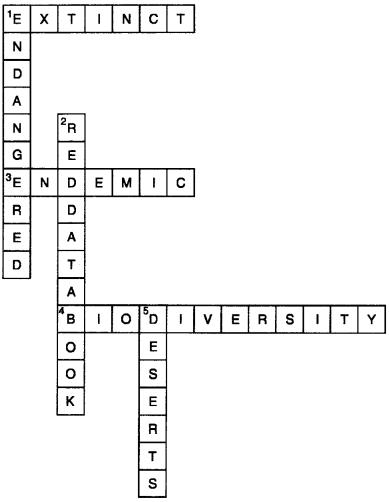
Complete the word puzzle
Down:
1. Species on the verge of extinction.
2. A book carrying information about endangered species.
5. Consequence of deforestation.
Across:
1. Species which have vanished.
3. Species found only in a particular habitat.
4. Variety of plants, animals and microorganisms found in an area.
Answer:
पौधों और जानवरों का संरक्षण कक्षा 8 नोट्स
→ वनों की कटाई जीवों के अस्तित्व के लिए एक बड़ा खतरा है।
→ पौधे प्रकाश संश्लेषण के लिए कार्बन डाइऑक्साइड का उपयोग करते हैं।
→ वनों की कटाई से पृथ्वी पर तापमान और प्रदूषण का स्तर बढ़ता है।
→ कार्बन डाइऑक्साइड की मात्रा में वृद्धि के परिणामस्वरूप ग्लोबल वार्मिंग होती है।
→ जीवमंडल पृथ्वी का वह भाग है जहाँ जीवित जीव निवास करते हैं।
→ जैव विविधता पृथ्वी पर पाए जाने वाले जीवों की विविधता है।
→ पचमढ़ी जीवमंडल एक संरक्षित क्षेत्र है।
→ संरक्षित क्षेत्र वे क्षेत्र हैं जिन्हें पौधों, जानवरों और उनके आवासों की रक्षा के लिए घोषित किया गया है।
→ जैविक महत्व के क्षेत्रों का संरक्षण हमारी राष्ट्रीय परंपरा का हिस्सा है।
→ स्थानिक प्रजातियाँ पौधों और जानवरों की प्रजातियाँ हैं जो विशेष रूप से एक ही क्षेत्र में पाई जाती हैं।
→ प्रजातियाँ जीवों का एक समूह हैं जो एक-दूसरे के साथ प्रजनन कर सकते हैं।
→ वन्यजीव अभयारण्य जंगली जानवरों और उनके आवासों के लिए संरक्षित क्षेत्र हैं।
→ राष्ट्रीय उद्यान पर्यावरण के संपूर्ण पारिस्थितिकी तंत्र के संरक्षण के लिए बड़े आरक्षित क्षेत्र हैं।
→ पारिस्थितिकी तंत्र किसी भी क्षेत्र के जैविक और अजैविक घटकों के संयोजन से बनता है।
→ विलुप्त जीव अतीत में मौजूद थे और अब मौजूद नहीं हैं। उदाहरण के लिए, डायनासोर।
→ लुप्तप्राय प्रजातियाँ वे जीवित प्रजातियाँ हैं जिनकी संख्या एक निश्चित सीमा से कम हो गई है।
→ लुप्तप्राय प्रजातियाँ रेड डेटा बुक में दर्ज हैं।
→ प्रवासी पक्षी वे पक्षी हैं जो जलवायु परिवर्तन के कारण अपने मूल आवास से दूर उड़ जाते हैं और लंबी दूरी तक प्रवास करते हैं।
→ 1 टन कागज़ बनाने के लिए 17 पूर्ण विकसित पेड़ों की आवश्यकता होती है। काटे जाते हैं।
→ पृथ्वी पर हरित संपदा को बनाए रखने के लिए अधिक वृक्षारोपण आवश्यक है।
→ वनरोपण दो तरीकों से किया जा सकता है: 1. सामाजिक वनरोपण और 2. प्राकृतिक वनरोपण।
→ पुनर्वनरोपण का अर्थ है नष्ट हुए वनों को पुनर्स्थापित करने के लिए नए पेड़ लगाना।
→ जैव विविधता: जीवमंडल में पाए जाने वाले अनगिनत प्रकार के सूक्ष्मजीव, पौधे और जानवर
→ जीवमंडल आरक्षित क्षेत्र: विशिष्ट भूमि और समुद्री पर्यावरण के संरक्षित क्षेत्र जहाँ मनुष्य, जंगली जीवों (पौधों और जानवरों) के साथ, भी इस प्रणाली का हिस्सा हैं।
→ वनों की कटाई: खुली जगह पाने के लिए बड़े पैमाने पर वन वृक्षों की कटाई
→ मरुस्थलीकरण: मृदा अपरदन के कारण उर्वरता का क्रमिक ह्रास, जिससे शुष्क रेतीली भूमि बनती है।
→ पारिस्थितिकी तंत्र: सभी सजीव कारकों और पर्यावरण की प्रणाली, निर्जीव कारकों की परस्पर क्रिया के परिणामस्वरूप निर्मित प्रणाली।
→ संकटग्रस्त प्रजातियाँ: एक प्रजाति जिसके जीवों की संख्या एक निश्चित सीमा से कम है।
→ स्थानिक प्रजातियाँ: एक प्रजाति जो एक बहुत ही नियंत्रित क्षेत्र में पाई जाती है और कहीं और नहीं पाई जाती।
→ विलुप्त: वे जीव जो जीवमंडल से लुप्त हो गए हैं या विलुप्त हो गए हैं।
→ जीव-जंतु: जीवमंडल के एक विशिष्ट क्षेत्र में पाए जाने वाले जानवर।
→ वनस्पति: जीवमंडल के एक विशिष्ट क्षेत्र में पाए जाने वाले पौधे। जीवमंडल
→ प्रवासी पक्षी: वे पक्षी जो हर साल एक निश्चित समय पर दूर-दराज के क्षेत्रों से उड़ान भरते हैं और लंबी दूरी तय करते हैं।
→ राष्ट्रीय उद्यान: जंगली जानवरों के स्वतंत्र आवास और प्राकृतिक संसाधनों के उपयोग के लिए आरक्षित क्षेत्र।
→ रेड डेटा बुक: एक ऐसी पुस्तक जिसमें लुप्तप्राय प्रजातियों का रिकॉर्ड होता है।
→ पुनर्वनीकरण: वनों की कटाई से कटे पेड़ों की जगह उसी प्रजाति के पेड़ लगाना। नए पेड़ लगाना।
→ अभयारण्य: एक ऐसा क्षेत्र जहाँ जानवरों और उनके आवासों को किसी भी तरह की गड़बड़ी से बचाया जाता है।
पाठ्यपुस्तक प्रश्न और उत्तर
प्रश्न 1.
रिक्त स्थान भरें:
(a) वह स्थान जहाँ जानवर अपने प्राकृतिक आवास में संरक्षित रहते हैं, कहलाता है।
(b) केवल एक विशेष क्षेत्र में पाई जाने वाली प्रजातियाँ कहलाती हैं।
(c) प्रवासी पक्षी __ परिवर्तनों के कारण दूर-दूर तक उड़कर जाते हैं।
उत्तर:
(a) वन्यजीव अभयारण्य
(b) स्थानिक प्रजातियाँ
(c) जलवायु।
प्रश्न 2.
निम्नलिखित में अंतर स्पष्ट कीजिए:
(a) वन्यजीव अभयारण्य और जैवमंडल आरक्षित क्षेत्र
(b) चिड़ियाघर और वन्यजीव अभयारण्य
(c) संकटग्रस्त और विलुप्त प्रजातियाँ
(d) वनस्पति और जीव-जंतु।
उत्तर:
(a) वन्यजीव अभयारण्य वह स्थान है जहाँ जंगली जानवर अपने प्राकृतिक आवास में संरक्षित रहते हैं। यहाँ जानवरों का अवैध शिकार या उन्हें पकड़ना प्रतिबंधित है। जैवमंडल आरक्षित क्षेत्र जैव विविधता जैसे पौधों, जानवरों और सूक्ष्मजीवों के संरक्षण के लिए उपयोग किए जाने वाले क्षेत्र हैं। इसमें कई वन्यजीव अभयारण्य और राष्ट्रीय उद्यान शामिल हैं।
(b) चिड़ियाघर वे स्थान हैं जहाँ कुछ जानवरों को सार्वजनिक प्रदर्शन के लिए कृत्रिम आवासों में संरक्षित किया जाता है।
वन्यजीव अभयारण्यों का उपयोग वन्यजीवों को उनके प्राकृतिक आवासों में सुरक्षित और संरक्षित रखने के लिए किया जाता है।
(c) वे प्रजातियाँ जो विलुप्त होने के कगार पर हैं और जिन्हें सुरक्षा और संवर्धन की आवश्यकता है, संकटग्रस्त प्रजातियाँ कहलाती हैं।
वे प्रजातियाँ जो अब पृथ्वी पर मौजूद नहीं हैं, विलुप्त प्रजातियाँ कहलाती हैं।
(d) वनस्पति शब्द का प्रयोग पौधों की विभिन्न किस्मों के लिए किया जाता है, जबकि जीव-जंतु सभी प्रकार के जानवरों के लिए किया जाता है।
प्रश्न 3.
वनों की कटाई के निम्नलिखित पर प्रभावों की चर्चा कीजिए:
(a) जंगली जानवर
(b) पर्यावरण
(c) गाँव (ग्रामीण क्षेत्र)
(d) शहर (शहरी क्षेत्र)
(e) पृथ्वी
(f) अगली पीढ़ी।
उत्तर:
(a) जंगली जानवर: वनों की कटाई से कई जंगली जानवरों के आवास नष्ट हो जाते हैं। वे अपने प्राकृतिक आश्रय के बिना मरने के लिए छोड़ दिए जाते हैं।
(b) पर्यावरण: वनों की कटाई पारिस्थितिक संतुलन में गड़बड़ी के कारण पर्यावरण पर प्रतिकूल प्रभाव डालती है। वायुमंडल में कार्बन डाइऑक्साइड की मात्रा बढ़ जाती है और ग्लोबल वार्मिंग व प्रदूषण का कारण बनती है।
(c) गाँव (ग्रामीण क्षेत्र): ग्रामीण वनों पर निर्भर हैं। उनका वनों से गहरा संबंध है। वनों की कटाई के कारण विभिन्न जंगली जानवर आस-पास के गाँवों में भाग जाते हैं और उनके लिए खतरा पैदा करते हैं। वनों की कटाई के कारण ग्रामीणों को फल, ईंधन, लकड़ी नहीं मिलेगी और वर्षा भी कम होगी।
(d) शहर (शहरी क्षेत्र): वनों की कटाई का शहरों के जीवन पर सीधा प्रभाव नहीं पड़ता, लेकिन जलवायु परिवर्तन शहरों को प्रभावित करते हैं। बाढ़ और सूखे जैसी आपदाएँ शहरों को भी नहीं बख्शतीं।
(e) पृथ्वी: वनों की कटाई से पृथ्वी प्रभावित होती है। पृथ्वी की उपजाऊ भूमि रेगिस्तान में बदल जाती है और उसका तापमान बढ़ जाता है। भूजल स्तर भी कम हो जाता है। इससे जलवायु और पर्यावरण में बदलाव आता है।
(f) अगली पीढ़ी: वनों की कटाई के कारण कई खूबसूरत जीव-जंतु और वनस्पतियाँ नष्ट हो जाती हैं। इसलिए, अगली पीढ़ी उन्हें देख नहीं पाएगी। उन्हें स्वच्छ और ठंडा वातावरण नहीं मिलेगा। उनके पास स्वस्थ वातावरण नहीं होगा।
प्रश्न 4.
क्या होगा यदि:
(a) हम पेड़ों को काटते रहें।
(b) किसी जानवर के आवास में गड़बड़ी हो।
(c) मिट्टी की ऊपरी परत उजागर हो जाए।
उत्तर:
(a) यदि हम पेड़ों को काटते रहें तो:
पारिस्थितिक संतुलन बिगड़ जाएगा।
पृथ्वी की ऊपरी उपजाऊ परत खत्म हो जाएगी और यह रेगिस्तान में बदल जाएगी।
बाढ़ और सूखे की घटनाएँ बढ़ जाएँगी।
कई जानवरों के आश्रय छिन जाएँगे।
फल, कागज़ जैसी चीज़ों की कमी हो जाएगी जो हमें जंगलों से मिलती हैं।
(b) जब जानवरों के आवास में गड़बड़ी होती है, तो वे असुरक्षित और असंरक्षित हो जाते हैं। वे संकटग्रस्त हो जाते हैं।
(c) मिट्टी की ऊपरी परतें उपजाऊ होती हैं। यदि वे उजागर हो जाएँ, तो वे अपनी उर्वरता और ह्यूमस खो देती हैं। इससे मरुस्थलीकरण होता है।
प्रश्न 5.
संक्षेप में उत्तर दें:
(a) हमें जैव विविधता का संरक्षण क्यों करना चाहिए?
(b) संरक्षित वन भी जंगली जानवरों के लिए पूरी तरह सुरक्षित नहीं हैं। क्यों?
(c) कुछ आदिवासी जंगल पर निर्भर हैं। कैसे?
(d) वनों की कटाई के कारण और परिणाम क्या हैं?
(e) रेड डाटा बुक क्या है?
(f) प्रवासन शब्द से आप क्या समझते हैं?
उत्तर:
(a) जैव विविधता को विलुप्त होने से बचाने के लिए उनका संरक्षण किया जाता है।
पुस्तकालय
(b) संरक्षित वन भी वन्यजीवों के लिए पूरी तरह सुरक्षित नहीं हैं क्योंकि इन क्षेत्रों में बड़े पैमाने पर अवैध शिकार होता है। शिकारी इन संरक्षित क्षेत्रों में जंगली जानवरों को मार देते हैं।
(c) कुछ आदिवासी अपने भोजन, कपड़े, आवास और अन्य आवश्यकताओं के लिए जंगल पर निर्भर हैं।
(d) वनों की कटाई शहरीकरण और औद्योगीकरण के कारण होती है। वनों की कटाई मरुस्थलीकरण और प्राकृतिक आपदाओं के लिए ज़िम्मेदार है। वनों की कटाई के कारण पौधों और जानवरों की कई प्रजातियाँ नष्ट हो जाती हैं।
(e) रेड डाटा बुक सभी लुप्तप्राय जानवरों और पौधों का रिकॉर्ड बुक और स्रोत बुक है।
(च) जलवायु परिवर्तन के कारण पक्षियों की एक प्रजाति का अपने मूल स्थान से अन्य स्थानों की ओर आवधिक प्रवास प्रवास कहलाता है। प्रवास का उद्देश्य प्रजनन और गर्मियों के लंबे दिनों का आनंद लेना है।
पुस्तक अलमारियाँ
प्रश्न 6.
कारखानों में बढ़ती माँग और आश्रय की पूर्ति के लिए पेड़ों की लगातार कटाई की जा रही है। क्या ऐसी परियोजनाओं के लिए पेड़ों की कटाई उचित है? चर्चा कीजिए और एक संक्षिप्त रिपोर्ट तैयार कीजिए।
उत्तर:
किसी भी परियोजना के लिए पेड़ों की निरंतर कटाई उचित नहीं है। हम न केवल पेड़ों को काटते हैं, बल्कि उनके आश्रय भी छीन लेते हैं।
